Research Interests
Generally scheduling in queueing systems! Right now, I'm working on a few problems in designing and analyzing interpretable policies for realistic queueing systems:- Preemption-overhead-aware scheduling: extending preemption-overhead analysis to a broader family of priority policies (the SOAP family). Preemption overhead is the delay incurred any time a system interrupts service of one job to serve another, while preserving progress. This shows up in cloud schedulers, CPU dispatchers, etc.
- Connecting this theory to cloud computing: using it to inform decisions like when to use spot instances or migrate jobs between machines.
- Testing preemption-aware policy design on actual production traces, with an eye toward getting preemption-aware policies deployed.
- Data-driven scheduling (Empirical Gittins): evaluating how Empirical Gittins performs when the underlying job size distribution changes over time.
Skills
Programming: Python (NumPy, SciPy, Pandas, scikit-learn, PyTorch, MIP, SageMath), SQL, R, MATLAB, LaTeX, Git
Theoretical: Stochastic Control, Optimal Stopping, Queueing Theory, Data-Driven Decision Making, Machine Learning
Teaching
I am currently instructor of record for the first half of ORIE 3500 (Engineering Probability and Statistics II at Cornell. I am really passionate about teaching and mentoring. I believe that the best learning happens when both student and teacher know exactly what the student does and doesn't understand, so that they can bridge that gap together. As such, I am a big fan of frequent/low-stakes feedback and highly active lectures. I have built multiple tools of my own to bring my philosophy into practice (ask me about them, I would love to chat about them)!
Selected Preprints/Publications
- "Transform analysis of preemption overhead in the M/G/1."What's this paper about?
Most scheduling theory pretends that switching between jobs is instantaneous, like a cashier who can stop scanning customer A's items mid-checkout and begin scanning customer B's item with zero time delay (or irritation) between customers. This is not realistic, even in computer systems: swapping which job is running will incur a delay. In order to design good scheduling policies, we must balance the benefits of swapping jobs with the drawbacks. However, every classical queueing result ignores this delay because it was thought to be impossible to analyze. We develop a general tool to analyze this delay and apply it to a class of scheduling policies.
- "Empirical Gittins for Data-Driven M/G/1 Scheduling with Arbitrary Job Size Distributions."What's this paper about?
Suppose you never know exactly how long any one job will take, but you might know the precise probability of a job finishing at every point in time. Given that knowledge, there's a well-known ``best'' way to decide what job to run next (the Gittins index). The Gittins index uses how long a job has already run as a clue about how much longer it needs. The catch is that real systems usually don't know that underlying pattern precisely. They might only know how long previous jobs took. This paper shows that you can build a near-optimal priority rule using nothing but a few examples of past job sizes.
- "Numerical methods in sustainability."
- "Uniform scrambles on graphs."
- "Scramble number and tree-cut decompositions."
- "Bounds on higher graph gonality."
Ramakrishna, S. and Scully, Z. Submitted to Stochastic Systems. 1st Place Winner of 2024 ACM SIGMETRICS Student Research Competition, Graduate Division.
Ramakrishna, S.*, Harlev, A.*, and Scully, Z. Published in Proceedings of the ACM on Measurement and Analysis of Computing Systems (SIGMETRICS) (* Authors contributed equally to this work.) , Mar 2026.
Ramakrishna, S. Winner of the 2022 Mathematical Association of America Outstanding Student Mathematical Paper Prize.
Cenek, L., Ferguson, L., Gebre, E., Marcussen, C., Meintjes, J., Morrison, R., Ostermeyer, L., and Ramakrishna, S. Published in the Australasian Journal of Combinatorics, Aug 2023.
Cenek, L., Ferguson, L., Gebre, E., Marcussen, C., Meintjes, J., Morrison, R., Ostermeyer, L., and Ramakrishna, S. Preprint on arXiv, Sep 2022.
Cenek, L., Ferguson, L., Gebre, E., Marcussen, C., Meintjes, J., Morrison, R., Ostermeyer, L., and Ramakrishna, S. Preprint on arXiv, Jun 2022.
Recent Selected Talks
- Poster: "Empirical Gittins: M/G/1 Scheduling from Job Size Samples," Stochastic Networks Conference 2026, Chicago, IL.
- Talk: "Empirical Gittins for Data-Driven M/G/1 Scheduling with Arbitrary Job Size Distributions," ACM SIGMETRICS 2026.
- Talk: "To Infinity and Beyond: An Introduction to Branching Processes," De-stressing Math Collective, Bryn Mawr College, Apr 2026.
Selected Awards
- ACM SIGMETRICS Student Research Competition Graduate Division, 1st Place, 2024
- MAA EPaDel Outstanding Student Mathematical Paper Prize, 2022
- Anna Pell Wheeler Prize in Mathematics, 2022
- Mary Louise Cookson Prize in Mathematics, 2022
- Community Building Honor Roll, 2021 & 2022
Awarded for work on Transform Analysis of Preemption Overhead in the M/G/1. The winning research was recognized for its significant contribution, innovative methods, and effective presentation.
Awarded for master's thesis, Numerical methods in sustainability. The EPaDel Student Mathematical Papers Prize recognizes one outstanding paper written by an undergraduate student at an institution in the section that year.
Awarded annually to a single undergraduate at Bryn Mawr College on the recommendation of the Department of Mathematics, given solely on the basis of academic distinction and achievement in the field.
Awarded annually to a single graduating mathematics major in recognition of exceptional service that has contributed to the life of the department.
Recognizes and celebrates undergraduates, post-bacs, and graduate students who invest time and energy to create a sense of belonging, inclusiveness and community on campus.
About Me
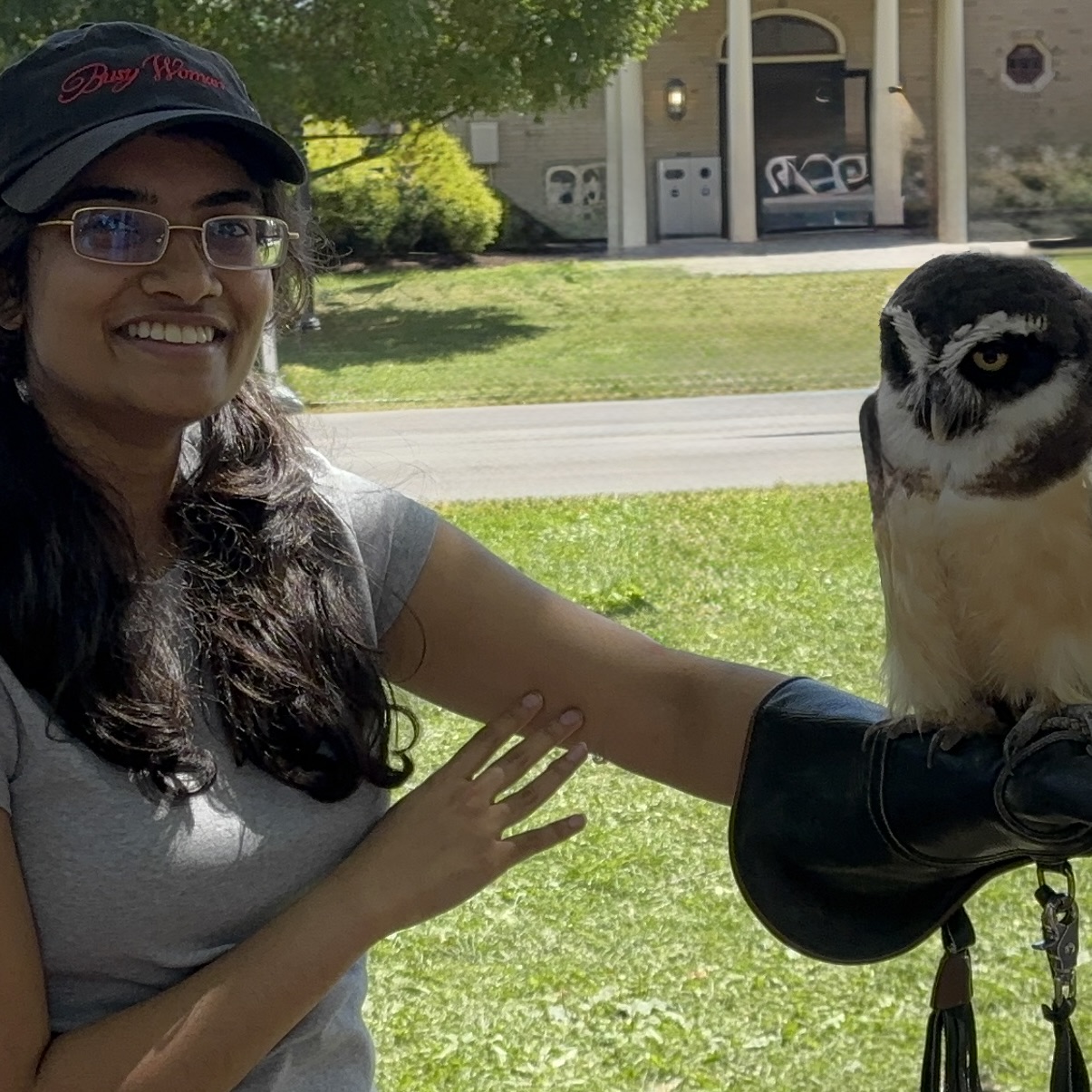
Hi! My name is Shefali (she/her). I am a fifth-year PhD candidate in Operations Research at Cornell University, working on scheduling in queueing systems. I am currently instructor of record for ORIE 3500, a 150+ student introductory probability and statistics course.
I have a bachelor's and master's degree in mathematics with honors from Bryn Mawr College, where I graduated magna cum laude.
When I’m not thinking about research "queue-stions", I enjoy birdwatching (ask me about American Robins and American Crows!), embroidery (particularly of birds), improv, turn-based tactics and strategy games, deckbuilding roguelikes, and Shakespeare plays!
My committee members are Ziv Scully, Jamol Pender, Izzy Grosof, and Mark Lewis.